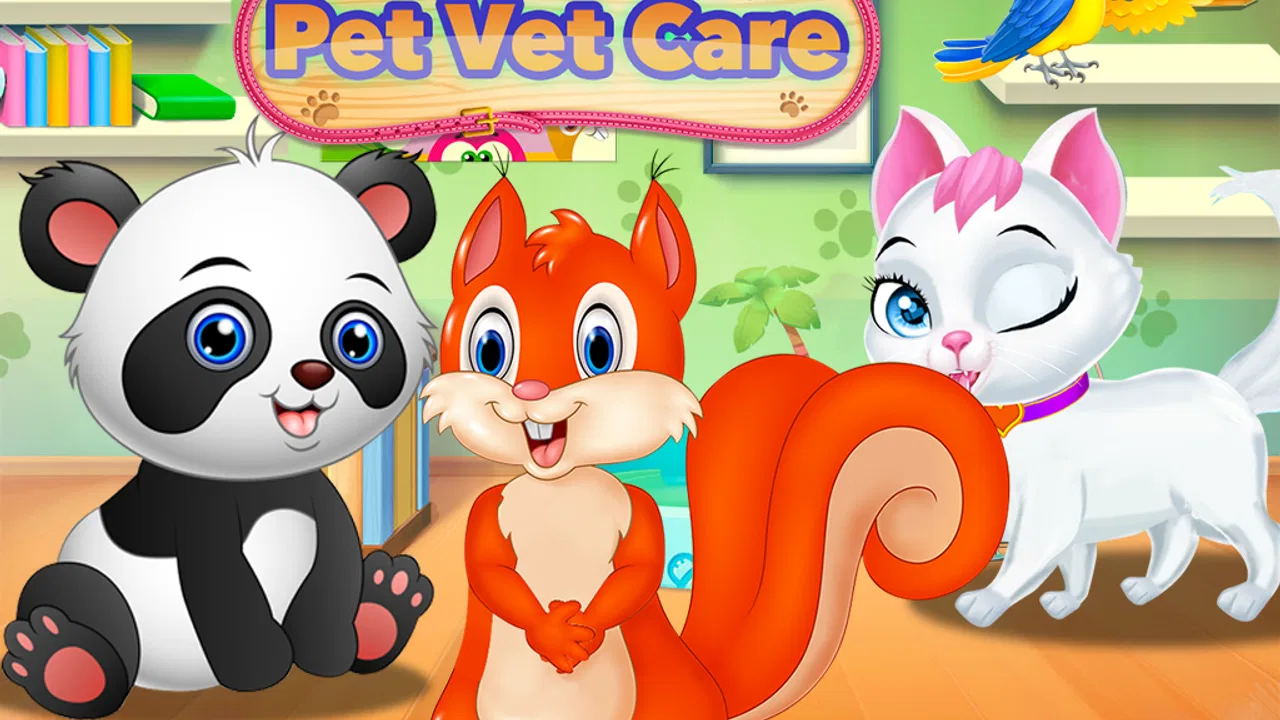
Pet Vet Care Wash Feed Animals
- 4.3
- Rating
- 10.00M
- Installs
- Free
- Price

 Analysis by App-foxy
Pet Vet Care Wash Feed Animals is the kind of game I would hand to a child who enjoys animals but is not ready for a complicated simulation. It turns simple pet-care actions into a gentle educational game: the player takes care of fluffy animals, gives them attention, and follows a routine that feels more like play than study. My first impression was that its appeal comes from clarity. You do not need to understand a long story, learn a complex control scheme, or manage a large collection of menus before getting started.
That simplicity also explains why the game has reached a broad audience. It is a free educational game from trochoi ltd co, rated for Everyone, and it has passed over ten million installs with an average rating of 4.3 from around eighteen thousand ratings. Those figures suggest that it is not a niche pet title aimed only at a very young audience. Still, I would treat that popularity as a starting point rather than a guarantee: whether it works for your family depends on how much repetition, gentle pacing, and child-friendly interaction you expect.
How the pet-care routine feels in everyday play
The main attraction is the feeling of playing veterinarian and caretaker without the pressure of a serious medical simulator. The animals are presented as lovable companions, and the basic idea is easy to understand even for someone who has never played a management game. In my experience, that makes it suitable for short sessions: a child can open it, recognize the purpose quickly, and begin caring for an animal instead of spending the first few minutes decoding instructions.
You May Also Like

 Blood Strike: 2.5 Anniversary
Blood Strike’s Loadouts Turn Every Drop Into a Tactical Gamble
A close look at Blood Strike’s custom loadouts: how fast access to signature weapons reshapes its battle royale rhythm, rewards preparation, and narrows the gap between fights.

 Pandora - Music & Podcasts
Pandora’s Music Is Easy to Start, but Harder to Recover
Pandora’s strength is its low-effort path from a seed to a station. Its weak spot is how much confidence it asks you to place in connection, setup, and quiet recovery.

 8 Ball Pool
 Is Built on Rivalries, Rematches, and Routine
A close look at the rivalries, rematches, shared routines, and unanswered safety questions that turn a quick pool match into a persistent mobile community.

 Samsung Music
’s Quiet Strength Is Playing What You Already Own
Its reach comes less from spectacle than from dependable access to a personal library. That simplicity is both the app’s strongest retention engine and its ceiling.

 AccuWeather: Weather Radar
AccuWeather Review: A Quick, Clear Forecast for Everyday Decisions
For everyday plans, the best forecast is the one you can understand quickly. AccuWeather makes rain timing, radar, and local conditions easy to act on, with a few trade-offs.

 Hill Climb Racing
Why Hill Climb Racing Still Turns Crashes Into One More Run
A tiny car, a bumpy hill and one more upgrade: Hill Climb Racing keeps resurfacing because its simple chaos makes every near-miss feel personal.
More From Our News Desk
View All News


A realistic use case would be a quiet moment after school. A child may want something more interactive than a cartoon but less demanding than a competitive game. This title can fill that gap because its theme gives the session a clear purpose. Rather than simply tapping through unrelated mini-games, the player is encouraged to think in terms of looking after an animal. That small shift matters: washing and feeding feel like parts of a routine, not isolated button presses.
I also see value in using it as a conversation starter. An adult can ask why an animal might need cleaning, food, or attention, then let the child explain what they are doing in the game. It should not replace real information about animal health, but it can make the subject approachable. The educational value is strongest when the game is played alongside a parent or older sibling who adds context instead of leaving the child to treat every action as a literal veterinary lesson.
What makes it approachable for younger players
The game’s biggest strength is its low entry barrier. The pet-care theme is immediately understandable, and the age rating of Everyone makes it a reasonable candidate for a shared family device. I would still watch the first session, not because the concept is difficult, but because children differ in how they react to repetition, optional purchases, and the pace of guided activities.
One useful approach is to let the child lead while an adult observes the sequence of care. If the child rushes through, ask them to describe what the animal needs before tapping. If they become distracted, shorten the session rather than turning the game into a required lesson. This keeps the experience playful and avoids making a simple animal game feel like homework.
There is also a practical advantage for families with mixed ages. A younger child can focus on the visible actions, while an older child can take responsibility for remembering the order of care. That creates two levels of engagement without requiring separate difficulty settings. The trade-off is that children looking for deeper strategy may find the routine too predictable after the novelty fades.
Speed expectations and the first few sessions
Pet Vet Care Wash Feed Animals is best approached as a light, accessible game rather than a demanding simulation. The current version is 1.0.28, and the minimum operating-system requirement is Android 4.4, which makes it compatible with a wide range of older Android devices. That broad compatibility is useful, but it also means I would not assume identical performance on every phone or tablet. A newer device may feel more comfortable during longer sessions, while an older one may be better suited to brief play.
In practical terms, I would expect the game to be most pleasant when the device has been given a moment to settle after opening. If a child is using an older phone with many other apps active, closing unused apps first is a sensible habit. This is not a special trick for the title so much as a way to reduce avoidable friction on modest hardware. The game’s simple premise does not automatically mean every device will respond identically.
The early experience should be judged by how quickly a child understands the care loop, not by how many activities can be completed in one sitting. A game like this succeeds when the controls stay out of the way. If the player can concentrate on the animal rather than on finding hidden commands, the perceived speed feels better even when the session itself is deliberately calm.
That calm pacing may disappoint players who expect rapid rewards or constant new challenges. I would not choose it for someone who wants arcade intensity, competitive rankings, or a large strategic system. Its appeal is closer to a digital pretend-play activity. The absence of pressure is a benefit for younger users, but it can feel slow to experienced players who want more control over progression.
Heavy-use moments: where the experience can feel different
The most demanding moments are likely to come from the device and the way the game is used, rather than from the animal-care idea itself. A short session with one child is a different test from leaving the game open while switching between it, video apps, and other games. On older hardware, repeated app switching can make any title feel less immediate. I recommend treating it as a focused activity instead of expecting it to remain open in the background all day.
Longer play can also expose a design limitation: simple care actions may begin to feel repetitive. That is not necessarily a performance fault, but it affects perceived responsiveness. When the player already knows what will happen next, even a quick interaction can seem slower because there is less discovery involved. Parents can address this by setting a small goal for each session, such as caring for one animal carefully and then stopping.
Another heavy-use situation is shared play. Two children may want to take turns, or a parent may join in to explain the actions. The game’s straightforward concept helps here, but turn-taking can reveal whether a child is enjoying the care process itself or merely waiting for a new reward. I found that asking the child to narrate the animal’s needs gives the session more substance than simply passing the device back and forth.
The free entry point is helpful, especially for families testing whether the theme suits them. However, in-app purchases range from ninety-nine cents to seven dollars and ninety-nine cents per item. I would review purchase controls before handing the device to a child. This is one of the most important practical steps because the game is aimed at a family-friendly audience, while optional spending can still change how comfortable the experience feels for parents.
Reliability, recovery, and keeping play comfortable
For a child-focused game, reliability means more than avoiding crashes. It also means that the child can understand what is happening, recover from a mistaken tap, and return to the activity without feeling lost. Pet Vet Care Wash Feed Animals benefits from having a familiar theme, so a child who pauses or steps away can usually reconnect with the idea of caring for an animal. That is a stronger recovery path than in a game built around a complicated story or a large set of rules.
I would still avoid judging stability from one quick launch. Try opening it on the intended device, play through several care actions, leave it briefly, and return to it. This simple check answers the questions that matter most for a family: does the device remain comfortable, does the child understand the next step, and does the session feel manageable without constant adult intervention?
If the game ever feels sluggish, my first response would be practical rather than dramatic: restart it, close other demanding apps, and make sure the device is not already struggling with storage or heat. Those are reasonable recovery steps for an older Android phone. They do not guarantee a perfect result, but they help separate a temporary device issue from a problem with the game itself.
The broad install base and the rating indicate that many people find the overall experience workable, yet they should not be read as a promise that every handset will behave the same way. Android devices vary widely in age and hardware. I would be particularly careful when installing it on a very old family phone that is already slow in other apps. A child notices delays quickly, and a gentle game loses much of its charm if every tap feels uncertain.
Device constraints and the cost of simplicity
The Android 4.4 minimum is a clear advantage for compatibility. Families do not need a recent flagship device simply to try the game, and that makes it easier to reuse an older phone or tablet for supervised play. At the same time, minimum compatibility should not be confused with ideal comfort. A device that can install a game may still offer a less pleasant experience if it has limited memory, a tired battery, or a screen that makes small interactions awkward.
For tablets, the larger display may be more comfortable for younger children because it gives them room to see the animal and the available actions. The trade-off is portability: a tablet is less convenient for a quick waiting-room session. On a phone, the game is easier to carry, but smaller controls can matter for children who are still developing precise touch habits. I would choose the device based on the child’s control and visibility needs rather than simply using the newest available screen.
Because the game is free to start, it is easy to test without committing money immediately. That makes it a better fit for families who are unsure whether their child will enjoy the veterinary theme. The purchase range means I would also decide in advance whether optional spending is allowed. A clear family rule prevents the child from confusing “free to download” with “nothing can ever cost money inside the game.”
Players who want a serious learning tool should understand the limits of this format. The game can encourage care-oriented thinking and imaginative play, but it is not a substitute for a structured lesson about animal biology, first aid, or responsible pet ownership. For those goals, a well-made educational video, a book, or an adult-led activity may offer more accurate depth. This title works better as an inviting introduction than as a complete course.
Three ways to get more value from the game
My first tip is to turn the care sequence into a memory exercise. After the child has played once, pause before each action and ask what should happen next. The child then uses the game to practice observation and order rather than tapping automatically. This small change makes the routine more educational without adding pressure or inventing a difficulty mode that the game may not provide.
My second tip is to use short, intentional sessions. Instead of leaving the game available indefinitely, choose a clear stopping point after caring for an animal or completing a small routine. This helps with the repetitive side of the design and makes the activity easier to fit into a real day. It is especially useful for children who become frustrated when a simple game stops feeling new.
My third tip is to pair the virtual action with a real-world question. After washing or feeding an animal in the game, talk about how real pets need appropriate food, clean water, gentle handling, and help from an adult or veterinarian when they are unwell. The important distinction is that pretend care is safe to explore, while real animal care involves responsibility and supervision. That conversation gives the game a purpose beyond entertainment.
A fourth useful habit is to test the title on the actual device before a planned trip. If you want to use it during travel or while waiting for an appointment, open it at home first, check that the child can navigate comfortably, and confirm that purchase settings match your expectations. This avoids discovering during a busy moment that the screen is too small, the phone is too slow, or the child needs more guidance than expected.
Who should choose it, and who should skip it
I would recommend Pet Vet Care Wash Feed Animals to younger players who love animals, enjoy pretend-play routines, and benefit from clear interactions. It is also a sensible choice for parents looking for a free starting point in the educational category. The Everyone rating and low minimum Android requirement make it easy to consider for a shared family device, while the animal theme gives adults a natural way to join the conversation.
I would be more cautious for children who need constant novelty. If your child quickly moves on from repeated washing, feeding, and care activities, the game may provide only a short burst of interest. Likewise, older players who want detailed diagnosis, resource management, or a realistic veterinary career simulation should look elsewhere. The title’s friendliness is also its boundary: it keeps the subject approachable by avoiding the complexity that those players may be seeking.
Compared with a standard puzzle game, this offers more imaginative context and a clearer emotional connection to the characters. Compared with a serious pet simulator, it is easier to enter but less likely to satisfy someone who wants long-term planning. Compared with an educational video, it gives the child something to do rather than simply watch, although it cannot provide the same depth of explanation. For me, that places it in a useful middle ground: interactive enough to invite participation, simple enough for casual family use.
My performance verdict
After considering speed, heavier use, recovery, and device demands, I see this as a lightweight-feeling game in concept, with its best performance profile coming from short, focused sessions on a reasonably maintained Android device. Its current version, 1.0.28, and wide Android compatibility make it accessible, while the free price lowers the risk of trying it. I would not promise identical smoothness on every older handset, but the design is simple enough that it does not ask the player to manage a complicated system before enjoying the animals.
The main limitation is not a lack of ambition so much as the narrowness of the routine. Once the novelty of playing caretaker fades, children may need an adult’s questions or a clear session goal to keep the activity meaningful. Optional purchases also deserve household attention, even though the game can be started without paying. Those are manageable concerns, but they are important when choosing an app for a child.
My recommendation is to try it when you want gentle animal-themed play with an educational angle, not when you want a deep veterinary simulation. I would install it for a younger animal lover, test it on the intended device, set purchase expectations beforehand, and use the care actions as prompts for real conversations about kindness and responsibility. With those expectations, Pet Vet Care Wash Feed Animals is an approachable free game from trochoi ltd co that can earn a place in a child’s short, supervised play sessions without pretending to be more complex than it is.
FAQs for Pet Vet Care Wash Feed Animals
01What is Pet Vet Care Wash Feed Animals?
Pet Vet Care Wash Feed Animals is a casual pet-care game for children and families. It lets players look after adorable virtual animals by washing them, feeding them, treating minor problems, and keeping them comfortable. The gameplay is designed around simple taps and gestures, making it easy to understand even for younger players who enjoy animal-themed activities.
02How do you play Pet Vet Care Wash Feed Animals?
The game presents different animals that need attention and care. Players can select activities such as bathing, cleaning, feeding, examining, or helping a pet recover. Each task generally uses straightforward on-screen controls, so there is no complicated tutorial to master. Progress comes from completing care activities and keeping the animals happy, clean, and healthy.
03Is Pet Vet Care Wash Feed Animals suitable for children?
Yes, the game is primarily aimed at children and casual players who enjoy friendly animal-care experiences. Its colorful presentation, simple interactions, and non-violent gameplay make it approachable for younger users. Parents should still review the app’s age rating, advertising settings, and in-app purchase information before allowing children to play without supervision.
04Does Pet Vet Care Wash Feed Animals require an internet connection?
The basic pet-care activities may work without a constant internet connection, depending on the version installed and the device being used. However, some features, advertisements, updates, or optional content may require access to the internet. It is best to launch the game once while connected and check which functions remain available when the device is offline.
05Is Pet Vet Care Wash Feed Animals free to download?
Pet Vet Care Wash Feed Animals may be available as a free download, but the exact pricing and included features can vary between Android and iOS versions. Free editions can sometimes contain advertisements or optional purchases for additional content. Before downloading, check the official store listing for current costs, permissions, subscriptions, and purchase details.
Pros
- Simple controls make it easy for younger children to play independently.
- Caring for different pets helps introduce basic animal-care routines.
- Bright visuals and friendly animations keep the experience inviting.
- Short activities are suitable for quick play sessions.
- Offline access allows play without a constant internet connection.
Cons
- Gameplay may feel repetitive after completing the same care tasks several times.
- Some features or items may be limited unless additional content is unlocked.
- The game offers little challenge for older children or experienced players.
- Frequent prompts or ads may interrupt play in the free version.
- Animal-care actions are simplified and do not replace real veterinary guidance.

Pet Vet Care Wash Feed Animals
Gallery